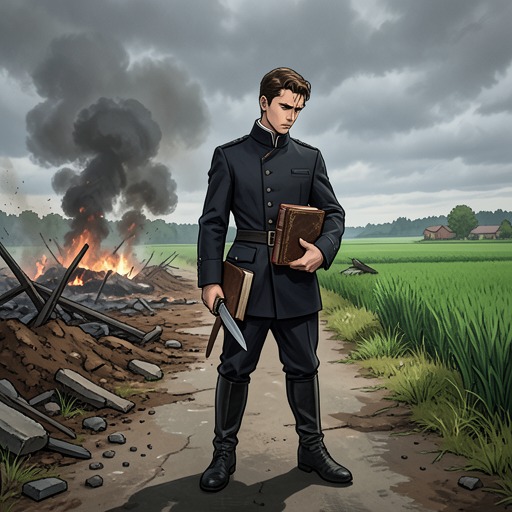
Captain Tushin
War and PeaceCaptain Tushin is a Russian artillery officer whose small stature and shy manner conceal exceptional steadiness under fire. At the Battle of Schöngrabern, his isolated battery continues fighting after its supports are withdrawn, fires the village, repels repeated French attacks, and remains at its position until an explicit order forces its retreat. The episode makes him a central example of how courage in war may appear unimpressive, improvised, and almost invisible to the authorities who later judge it.
Identity and Introduction
Captain Tushin first appears in an unheroic physical and social frame. He is a thin, dirty little artillery officer found without his boots because he has given them to the canteen keeper to dry. A staff officer rebukes him for failing to set a proper example and orders the officers back to their posts. Tushin responds with a shy attempt at humor, saying that the soldiers find it easier to stand without boots, but he immediately senses that the joke has failed and becomes confused. His large, intelligent, kindly eyes and uncomfortable shifting from one stockinged foot to the other establish a character whose gentleness does not fit the theatrical image of military command.
His appearance also connects him to the material hardships of the Russian army. The regiment arriving at Braunau has marched roughly seven hundred miles, while more than half its men have boots full of holes because the Austrian commissariat has not supplied replacements. Tushin's missing footwear therefore belongs to a larger world of exhaustion, shortage, and administrative failure rather than merely personal negligence. The contrast between immaculate parade preparation and damaged equipment exposes the distance between military appearance and the bodily conditions beneath it.
Tushin's conversation before the battle deepens this impression. He discusses the possibility of a future life, while another officer argues that human beings know only the atmosphere and not any literal sky. Tushin asks for herb vodka and continues trying to conceive of life after death, but a cannonball abruptly interrupts the unfinished reflection. His philosophical uncertainty is not separated from combat; thought, fear, bodily danger, and duty occupy the same cramped space.
The Battery at Schöngrabern
At Schöngrabern, Tushin acts without a precise order. His guns are intended to cannonade the valley, but no one has told him exactly where or what to fire at. After consulting his respected sergeant major, Zakharchenko, he decides to use incendiary balls against the village visible before the advancing French columns. The decision is practical and imaginative at once: he identifies a target that can disrupt the enemy even though the formal chain of command has left the battery without clear instructions.
When Prince Bagration reaches the battery, Tushin is absorbed in the work of directing the guns. He is short and round-shouldered, stumbles over the gun carriage, and shades his eyes while studying the field. His voice is weak, yet he tries to give it a dashing quality as he orders the elevation adjusted and calls for the gun to be fired. His salute is not a crisp military gesture but a bashful motion resembling a priest's benediction. The scene refuses to separate command from awkwardness: Tushin does not look like a heroic commander, but his attention governs the action around him.
The battery's achievement becomes clearer after its supports are removed during the fighting. Tushin's four guns remain effectively undefended, yet they continue firing. The French cannot imagine that anyone would dare maintain fire from such an exposed position, and therefore assume that the main Russian forces are concentrated there. They attack the point twice and are driven back by grapeshot. Tushin's battery thus exercises influence beyond its apparent strength: its persistence creates a false impression of Russian power and helps hold the center.
The burning village becomes both a tactical success and a moment of collective exhilaration. Tushin and his artillerymen watch the smoke and fire with childlike delight, shouting that it is fine and grand as the flames spread. When the French place ten guns against the battery, the danger becomes unmistakable. Balls kill horses, tear a driver's leg, and destroy equipment, while Tushin's companion officer is killed. The gunners replace the dead horses, carry away the wounded, and turn the four guns against the larger enemy battery. Their spirits do not collapse; excitement changes into determined labor.
Retreat and Recognition
The battery is forgotten until the end of the action. Prince Bagration, still hearing the cannonade, sends an orderly and later Prince Andrew to order Tushin to withdraw. A staff officer arrives first, shouting that Tushin has twice been ordered to retreat, but cannonballs repeatedly interrupt the reprimand and drive the officer away. Tushin can only raise two fingers to his cap and mutter in alarm. The exchange reveals a structural irony: the officer responsible for preserving the battery's formal obedience is forced to flee, while the supposedly disorderly captain remains at the guns.
Prince Andrew finds the position under terrible fire. An unharnessed horse with a broken leg screams beside the other horses, blood gushes from the wound, and dead men lie among the limbers. Only two of the four cannon remain uninjured; one shattered gun and one unicorn must be left behind. Prince Andrew delivers the order but stays to supervise the withdrawal, removing the surviving guns with Tushin while they step across bodies under French fire. An artilleryman points out that a staff officer has already escaped and tells Prince Andrew that he is unlike that officer. Prince Andrew does not answer, but his presence supplies the practical courage that the official command has failed to provide.
The parting between the two men is unexpectedly intimate. Prince Andrew holds out his hand, and Tushin calls him a dear fellow and a dear soul; tears suddenly fill Tushin's eyes for an unexplained reason. Their farewell is not a public ceremony and produces no immediate triumph. It is a brief recognition between men who have shared danger, made more affecting by the fact that the institution around them has not properly seen what Tushin has done.
At the later report, the official record turns against him. Bagration asks how one gun came to be abandoned, and the officers laugh. Only then does Tushin fully feel the disgrace of losing two guns while remaining alive. He cannot explain that there were no covering troops, because he fears placing another officer in difficulty. Instead, he stands trembling and looks at Bagration like a schoolboy before an examiner. His silence is protective rather than evasive: even under accusation, he refuses to defend himself by exposing someone else.
Prince Andrew breaks the silence. He reports that two-thirds of the men and horses were knocked out, that two guns were smashed, and that there had been no supports at all. He then states that the day's success was chiefly owed to Tushin's battery and the heroic endurance of Tushin and his company. This intervention restores the truth that the official questioning has obscured. Tushin thanks Prince Andrew for saving him, while Prince Andrew says nothing and leaves sadly, troubled by the gulf between the reality of battle and the conduct of those who claim to evaluate it.
Wounds, Memory, and War's Logistics
Tushin later reappears in a military hospital, now a thin little man with one arm. Walking in a nightcap and hospital dressing gown, he recognizes Nikolai Rostov and reminds him that he once gave him a lift at Schöngrabern. The empty sleeve condenses the cost of the earlier action into a visible bodily absence. His survival is not a return to untouched normality; the officer who once directed four guns now moves through the hospital with a permanently altered body.
The hospital scene places Tushin's personal wound beside the wider attrition of military life. The wards contain sick and wounded officers, while the soldiers' ward carries the smell of decomposing flesh and holds men whose sickness and injuries are treated as part of the campaign's routine. Elsewhere, the Pavlograd regiment loses nearly half its men to hunger and illness despite suffering only two wounded in action, because provisions and fodder fail during a muddy spring thaw. The army's fate is therefore shaped not only by battles but by boots, food, horses, roads, hospitals, and transport. Tushin's damaged battery belongs to this same history of material endurance.
The broader campaigns reinforce the lesson of his episode. The Russian army retreats before a much larger French force, fights rearguard actions mainly to preserve its heavy equipment, and loses men through exhaustion, sickness, and abandonment. Later, the French army itself disintegrates during the retreat from Moscow: seventy-three thousand men are reduced to thirty-six thousand between Moscow and Vyazma, with no more than five thousand lost in battle. These figures make Tushin's experience representative rather than exceptional. War's decisive forces are often gradual and logistical, while public narratives prefer visible commanders, formal orders, and easily assigned blame.
Narrative Significance
Captain Tushin embodies the novel's anti-heroic account of warfare. His decisive work is performed by a man who lacks imposing looks, polished speech, secure equipment, and institutional protection. He improvises under unclear orders, maintains fire from an exposed battery, accepts losses without abandoning his position, and then faces humiliation because the surviving guns are counted more readily than the service they rendered. His courage is practical rather than self-dramatizing.
He also exposes the difference between military appearance and military reality. At Braunau, soldiers spend the night cleaning themselves and their equipment so that two thousand men will appear perfectly ordered, even though many lack usable boots. At Schöngrabern, Tushin's battery appears weak and unsupported, yet its action shapes the enemy's understanding of the battlefield. In both cases, outward form misleads: immaculate presentation can conceal deprivation, while physical awkwardness can conceal command.
Tushin's recurring association with bare feet, missing equipment, bodily injury, and shy speech prevents heroism from becoming an abstract moral label. The narrative keeps returning to what war does to bodies and supplies: boots wear out, horses scream, men are knocked out, guns break, food disappears, and hospitals overflow. Against this background, Tushin's achievement is not the product of isolated grandeur but of endurance within a damaged system. His importance lies precisely in the way the novel makes that endurance visible before official judgment tries to reduce it to a lost gun.